

“We need WiFi the entire premises”—don’t we?
When event organizers think about their festival in terms of the internet, most of them have a specific image in mind: comprehensive WiFi the entire venue. It sounds logical—but in most cases, it’s neither necessary nor economically viable.
The key question isn’t “How do I cover the entire site?”, but rather: What exactly is supposed to happen on the site—and where? The answer to that question determines what technology you need and what the whole thing will cost in the end.
This article provides practical guidance: What options are available? What are the pros and cons? And how do you find the right balance between value and budget?
What is the internet even used for at the festival?
Before you start thinking about technology, you should define the specific needs of your festival. After all, not every area requires the same solution—and not every area needs internet access at all.
Typical needs at festivals can be divided into three categories:
Infrastructure
Everything that keeps the event running: point-of-sale systems for cashless payments, ticket scanners at the entrance, and security communications. Reliability is paramount here. If the payment system fails, revenue comes to a standstill.
Organization
The back-office team needs access to emails, cloud documents, planning tools, and internal systems. A stable internet connection is essential for their work.
Guests
Visitors want to share photos, use the festival app, and chat with friends. Nice to have, but not essential for the event.
These three areas have completely different requirements in terms of bandwidth, availability, and security. We describe in detail how to implement this technically—that is, how to clearly separate the networks—in our article on segmenting festival networks.
Here, we’ll focus on the question that came before: How does the internet even get to your festival grounds—and how do you distribute it there?
The two main problems: bandwidth and distribution
When it comes to internet access for festivals, there are two key issues you need to address one after the other:
Problem 1: Getting internet access there
First, your festival grounds need an internet connection—that is, bandwidth, which serves as the “raw material,” so to speak. Depending on where your festival is taking place, there are several options:
- Fiber-optic connection – If the venue has a dedicated line, this is the most reliable and fastest option.
- Mobile Network Aggregation (Bandwidth Bonding) – Multiple LTE and 5G connections from different providers are aggregated into a single, stable connection. Ideal for locations without fixed infrastructure.
- Satellite –For remote areas where neither fiber-optic internet nor adequate cellular coverage is available.
- Combination – In practice, we often combine multiple technologies to achieve maximum redundancy. If one connection fails, the others continue to operate.
The amount of bandwidth you need depends directly on what activities are planned on the premises. You’ll need significantly less for 20 checkout stations than for comprehensiveWiFi thousands of simultaneous users.
Problem 2: Providing Internet access throughout the premises
The available bandwidth must reach the places where it is needed. And this is where things diverge—depending on the size of the site, the number of users, and the budget, there are fundamentally different approaches.
Option A: Internet hotspots – WiFi specific locations
The simplest and often most cost-effective solution: Instead of covering the entire site, you provide internet access only to the specific locations that need it.
How Internet Islands Work
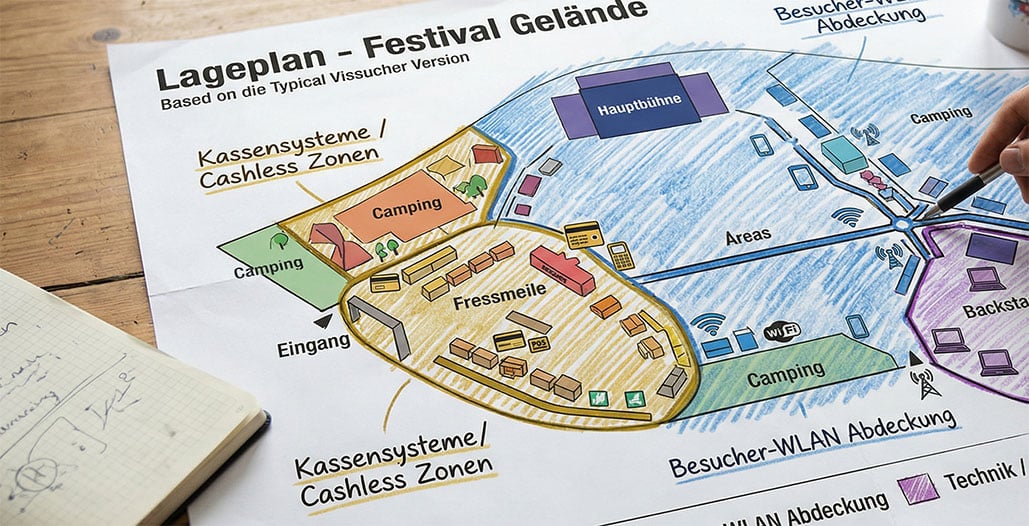
An Internet island is a self-contained, compact system consisting of a router, one or more access points, and its own Internet connection (often via a mobile data plan). The system provides WiFi coverage for a limited area: a sales booth, the entrance, the backstage office, or a cashless payment station.
Each island operates independently. This means that if one island goes down, all the others continue to function. And if something changes at the last minute—such as adding a booth or relocating an area—simply set up another island.
When Internet kiosks are the right choice
- You only need internet access in certain areas, not everywhere.
- The number of service points is manageable (e.g., 5–30 stations).
Advantages and Limitations of WiFi
The biggest advantage: You only pay for what you actually need. The systems are compact, some can even be assembled by the user, and they operate independently of one another—no single point of failure.
The limitations lie in scalability: there is no comprehensive coverage of the site, noWiFi the entire audience, and once the number of access points reaches a certain threshold, the concept becomes more complex than a unified solution.
Option B: Private LTE – Internet coverage for the entire festival grounds
When Wi-Fi hotspots are no longer enough, Private LTE comes into play. The principle: Instead of setting up many individual WiFi, we establish our own LTE mobile network that covers the entire site.
How Private LTE Works
Private LTE uses its own frequency band, which we reserve for your event through the Federal Network Agency. This network is exclusively for your festival—no other users transmit on it, and it cannot become overloaded.
The difference from the public cellular network: Telekom, Vodafone, and others provide coverage for visitors via their cell towers—but as an event organizer, you have no control over this. If 30,000 people open Instagram at the same time, the public network crashes. Your private LTE network remains completely unaffected.
Internet for Festivals: The Hybrid Model in Practice
In practice, we combine Private LTE with WiFi a flexible hybrid model:
The LTE signal covers the entire site. Any device with one of our SIM cards connects automatically—payment terminals, security devices, and crew cell phones.
WiFi you need it: For devices without a SIM slot—such as laptops in the backstage office, printers, and certain point-of-sale systems—we provide compact converter units. These units receive the LTE signal and convert it into a local WiFi. Simply place the unit where you WiFi —and you’re all set.
The big advantage: maximum flexibility. Does the location of a sales truck change five minutes before the event starts? No problem—just set up the unit, and you’re online right away. After all, LTE coverage is already available everywhere.
When Private LTE Is the Right Choice
- A large, sprawling festival grounds where standard WiFi its limits.
- Many mobile locations that may change at short notice.
- Crew communication across the entire site.
- High standards for reliability and independence from the public cellular network.
Advantages and Limitations of Private LTE
The advantages: comprehensive coverage, never overloaded, a dedicated frequency, and the case system enables WiFi any location. For the crew, this means that everyone communicates via their own network—no radios required.
The limitations: Devices require a SIM card or a WiFi. Planning is more complex than with individual WiFi. And Private LTE is only cost-effective for sites of a certain size.
Crew Communication: Everyone has a cell phone—why not use it?
One aspect of internet access at festivals that is often underestimated is internal communication. At large events, the public cellular network regularly reaches its limits. For visitors, this is a digital detox—for the organizing team, it’s a real problem.
Traditional walkie-talkies solve some of these issues, but they have drawbacks: limited range, additional devices that need to be distributed and collected, and no support for messaging apps, images, or cloud access.
With your own festival network—whether Private LTE or WiFi key locations—your team can communicate using their own smartphones. Messaging, calls, shared documents—everything works as usual. With Private LTE, every employee receives a SIM card or a small pocket router that fits in their pocket, ensuring they can be reached throughout the entire venue.
New: One-stop solution for internet and payment services for festivals
Internet access at a festival isn’t an end in itself—it’s the digital foundation on which all other services are built. And in most cases, the most important of these services is cashless payment.
That’s why we offer a complete package: internet, signal distribution, and cashless payment infrastructure—all from a single source. This means:
- We provide internet service (fiber optic, bonding, satellite—depending on the location).
- We distribute the signal throughout the premises (WiFi, private LTE, or a hybrid system).
- We supply the payment hardware and ensure that cash registers, terminals, and billing systems operate reliably.
The benefit for you: a single point of contact for everything. No coordination issues between your internet service provider and payment provider. If a terminal isn’t working, we’ll take care of it—instead of two service providers passing the buck to each other.
Planning Internet Access for Festivals: What to Consider
Whether it's WiFi, private LTE, or hybrid solutions—a few basic principles always apply:
1.) Set priorities: First things first
Start with the areas that keep the festival running: payments, ticket check-in, and security. Next comes the back office. And only after that—if the budget and bandwidth allow—theWiFi.
Those who take the opposite approach—WiFi comprehensiveWiFi —often end up spending their entire budget on it and, in the end, have no adequate solution for the truly critical systems.
2.) Use your budget wisely
Internet for festivals doesn't have to cost a fortune. If you clearly define your needs and choose the right technology, you can get a professional solution even on a modest budget. WiFi are often more affordable than you might think—and private LTE is a worthwhile investment as soon as the venue is large enough.
3.) Plan ahead
The sooner you factor internet connectivity into your festival planning, the better. This allows us to visit the site, assess the mobile network coverage, recommend the right technology, and set up the infrastructure in time. Last-minute requests are certainly possible—but planning ahead leads to better results and is usually more cost-effective.
Checklist: The 6 Most Important Questions About Internet Access for Your Festival
- What must absolutely be working on the premises (payment, admission, security)?
- How large is the site, and where are the supply points located?
- Is there an internet connection on site, or does everything have to be done via mobile devices?
- How many employees need access to the internal network?
- Should thereWiFi —and if so, should it be available throughout the entire space or only at specific locations?
- Should cashless payments be the only payment option?
WiFi or private LTE? A quick overview.
| Criterion | WiFi hotspots | Private LTE | Hybrid (LTE + WiFi) |
|---|---|---|---|
| Typical size | 5,000 m² to 50,000 m² (small open-air events) | 5,000 m² to 500,000 m²+ (medium-sized festival grounds) | 10,000 m² to 500,000 m²+ (large festivals lasting several days) |
| Supply | 5–20 individual locations (e.g., cash register, entrance) | Entire premises, one signal (via SIM cards) | Coverage via LTE + WiFi hotspots (combination as needed) |
| Structure | Self-assembly or installation by our team | Installation by the Eventnet team | Installation by the Eventnet team |
| Introduction | starting at 1 week | Starting at 4 weeks, including frequency registration | Starting at 4 weeks, including frequency registration |
| Last-minute changes | New island (~30 min. per location) | Online anywhere with a SIM card (0 min.) | Set up WiFi(~5 minutes per location) |
| Guest-WiFi | At individual spots (surf islands) | - | Can be used selectively (entire areas or specific spots) |
| Typical introduction | € (starting at a few hundred € per day) | €€ (worth it starting from a medium size) | €€€ (Complete package, scalable) |
Your festival, your needs – we’ll find the right solution
Every venue is different, and every organizer has different priorities.
That’s exactly why we start every project with a conversation:
- What do you really need?
- What is a nice-to-have?
- How can we allocate the budget to ensure that critical systems run reliably?
Let's talk about your festival.